Well, there were actually two winners! The decision was so tough. But today We'll show you the 2nd place winner. Here is their poem:
Christmas is a great place to be

A Candymaker in Indiana wanted to make a candy that would help us remember who Christmas is really about. So he made a Christmas Candy Cane. He incorporated several symbols for the birth, ministry, and death of Jesus Christ.
He began with a stick of pure white, hard candy. White to symbolize the virgin birth and sinless nature of Jesus. Hard candy to symbolize the solid rock, the foundation of the Church, and firmness of the promises of God.
The candymaker made the candy in the form of a "J" to represent the name of Jesus. It also represented the staff of the "Good Shepherd".
The candymaker then included red stripes. He used three small stripes and a large red stripe to represent the suffering Christ endured at the end of his life.
The candy became known as a Candy Cane - a decoration seen at Christmas time. The meaning has faded, but still gives joy to children young and old, whom Jesus loves and treasures.
http://www.homeschooled-kids.com/candycanelegend.html Thanks!
Anyway, Even Though is not Christmas-ish. We have a new song. Ya you've probably heard it. It's surfing the top hit charts and radios! *DrumRoll*
Put your Hands together for IYAZ!
Article from: About the Hottest TOy this Season!
http://www.articlesbase.com/shopping-articles/the-hottest-christmas-toy-zhu-zhu-pets-review-1446922.html
Zhu Zhu Pets have taken the toy industry by storm and are consuming most of the spots on the list of the Top Ten Toys for Christmas. In this article, we will have a look at Zhu Zhu pets including what they are and why the heck they are so popular.
So, how popular are Zhu Zhu Pets? The chief executive officer of Toys R Us said that they may not include Zhu Zhu Pets in their catalogue due to overwhelming demand and he did not want to disappoint customers if they were unavailable. If Toys R Us may not be able to stock them, you know that Zhu Zhu Pets are considered the best toys for Christmas 2009!
Zhu Zhu Pets are made by a company called Cepia out of St. Louis, Missouri. The company, only recently founded in 2004 by Russel Hornsby, realized the potential of these little critters when they flew off the shelves after their initial release. The product line has been so popular that Cepia has had difficulty keeping up with demand. Thus, Zhu Zhu Pets are often hard to find and are sometimes priced higher due to demand.
What are Zhu Zhu Pets?
They are little Hamsters that come in five different characters: Patches, Chunk, PipSqueak, Mr. Squiggles, and Num Nums. These five different hamster characters can function on their own but they are much more fun when you purchase the accessories to create a hamster habitat.
A good way to begin the adventure is with the Funhouse Set with Hamster. This will get you started with 1 hamster, Patches, and a funhouse environment. The package includes a large kitchen and living room, a hallway, and bathroom areas. This is the beginning of your Hamster Habitat.
If your kids enjoy this initial set, then you will want to purchase the other Hamsters as well more accessories for the funhouse. This allows you to see the full "intelligence" of the hamsters as they play in their habitat and make interesting sounds and funny movements.
Zhu Zhu Pets are designed for ages 3 and up but are probably are not good gifts for teenagers as they appeal to those under 10 year old. My kids, ages 3 and 5, enjoyed all the add-on accessories to the Hamster habitat but probably enjoyed the Hamster Wheel and the Add on Garage the most. With the Hamster wheel, you get to see the little robotic hamsters make the wheel spin and then slide down the ramp afterward. And with the Add on Garage, you get a sedan car and garage allowing the hamster to cruise around your house.
The enormous popularity of the Zhu Zhu Pets is a testament to how much the kids enjoy this toy. Kids love little snuggly pets as well as moving objects. Zhu Zhu Pets combine these two elements to make for the most popular toy this Christmas.
Skittles are insanely tasty little morsels. Rather like little bits of Starburst covered in a candy shell. Skittles were first introduced in 1974 in the UK and parts of Europe. They spread to the States as an import for a while and then in 1981 Mars began making them in the States.
Obsessive folks (perhaps I’m one of them and speaking from experience) like to divide up the colors and eat them. I usually eat mine in pairs of same flavors, but when it comes down to the end of the pack, there are certain acceptable combos (all the citruses can be paired and grape and strawberry can go together ... strawberry and lemon are also acceptable but never ever put orange and grape together).
Original Fruit Skittles
So, if you follow the guidelines, Neko and Teko will judge your poem and you just might win. If you win, the prize is that your poem will be published on our site and you will receive recognition.
This is Neko and Teko, encouraging you to pick up your pens.
NASA has announced that it found a "significant amount" of water on the moon as a result of the LCROSS impact last month.
Anthony Colaprete, a scientist on the project, estimated there were about 100 litres of water in the crater where the LCROSS spacecraft hit the moon on Oct. 9.
Colaprete presented some of NASA's data from the spacecraft's instruments, including spectrometer readings that strongly suggest the presence of water.
"Indeed, yes, we found water," Colaprete said at a news conference Friday. "There's not just water, but lots of water."
NASA scientists said the lunar crater they hit was actually wetter than some of the driest deserts on Earth.
NASA's discovery is the result of intentionally crashing the Lunar Crater Observation and Sensing Satellite into the moon and analyzing the explosion and crater that resulted.
There were actually two impacts, the first coming when a rocket stage that had carried a lunar probe hit the crater Cabeus, near the moon's south pole, creating a small crater of its own.
The LCROSS satellite observed the impact, as did the Lunar Reconnaissance Orbiter, the Hubble Space Telescope, three other Earth-orbiting satellites, and telescopes in the western U.S. and Hawaii.
Then, the satellite itself hit the moon. The two impacts created a crater between 20 and 30 metres across, and a plume between 10 and 12 kilometres across.
Colaprete said vapour from the explosion was detected as high as 20 kilometres above the moon's surface.
The impact didn't result in an explosion that was immediately visible, but NASA said it received a great deal of information from the experiment.
"We are ecstatic," Colaprete said in a NASA statement. "Multiple lines of evidence show water was present in both the high angle vapour plume and the ejecta curtain created by the LCROSS Centaur impact.
"The concentration and distribution of water and other substances requires further analysis, but it is safe to say Cabeus holds water."
Colaprete said he wasn't sure what the other substances might be, because the mission's focus was on finding water, but they could include carbon dioxide, methane, ethanol or methanol.
"All those are possibilities, but we really need to do the work to see what fits best," Colaprete said.
The researchers also saw sodium in the impact. All of these chemicals are seen in other bodies in space, such as comets, which could indicate the source of the moon's water.
The water on the moon could also come from solar wind or the Earth, or it could be that the water's always been there, NASA said.
Colaprete said some of these chemicals were found on moon rocks retrieved by Apollo astronauts, but their presence was explained away as contamination from the Earth. He said the possibility of contamination from the rocket stage or LCROSS itself has been ruled out.
The NASA researchers said water on the moon could be used by a future human settlement there, not just for drinking and bathing, but as a component for rocket fuel, if manned missions are ever launched from the moon.
"The moon still has many secrets," said Greg Delory, a senior fellow at the Space Sciences Laboratory for Integrative Planetary Sciences at the University of California, Berkeley.
Delory, who was not on the LCROSS team, said the mission's data "is painting a really surprising new picture of the moon. This is not your father’s moon. Rather than a dead and unchanging world, it could be a dynamic and interesting one.”
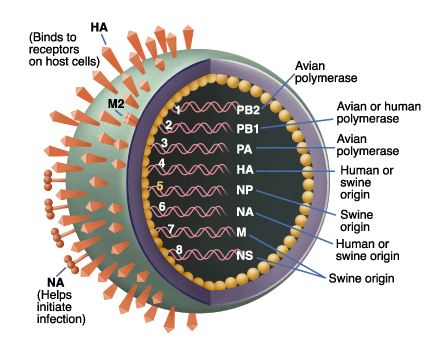
The new data from LCROSS appears to agree with a finding from India's Chandrayaan-1 lunar satellite, which in August found a chemical signature for water all over the moon's surface.Q: My three-year-old daughter got the flu two weeks ago. The doctor said it was H1N1 but it was not confirmed because the region doesn’t do routine testing. My husband and I did not get sick. How can this be? We took no special precautions. Now we’re wondering: Should we get the vaccine or are we immune to this flu?
A: You have raised several interesting issues related to H1N1 and vaccination. First, about 90 per cent of all the flu cases in Canada today are caused H1N1. There is very little seasonal flu so far. That’s why doctors assume that cases of the flu are H1N1. Testing everyone is not considered a good use of resources.
Second, there is a common assumption that everyone exposed to the H1N1 virus will get the flu. In fact, the large majority of people exposed to the virus will not get sick.
Even though you were in close contact with someone sick with swine flu, healthy young adults like yourselves have powerful immune systems that fight off a constant barrage of pathogens. When you are exposed to a virus, your body will produce antigens and develop immune resistance. In some people, this happens with very few disease symptoms; others will get quite sick. A vaccine does the same thing by tricking the body into thinking it is being exposed the virus.
Many people argue that there is no need to be vaccinated, that we should depend on our immune systems and bolster them with good nutrition. That is a bit of a gamble.
With H1N1, a new strain, it is anticipated that about one-third of the population will get sick. To date, it is estimated that about five per cent of Canadians have fallen ill with H1N1, so a lot more sick people are expected in the coming months.
While it is true that most cases of the flu are “self-limiting” – meaning you get better with rest and fluids, in rare instances people can get gravely ill and die. Again, the risk of complications is greatest in those with weaker immune systems – babies, children, people with chronic health conditions – but some healthy people will get severe illness.
So far in Canada, 1,779 people have been hospitalized with H1N1, including 351 who ended up in intensive care and required ventilators. There have been 92 confirmed deaths.
That is why public health officials recommend that everyone by vaccinated unless they had a laboratory-confirmed case of H1N1. That would include you and your daughter. Even if you have immunity to H1N1, the vaccine will do no harm.