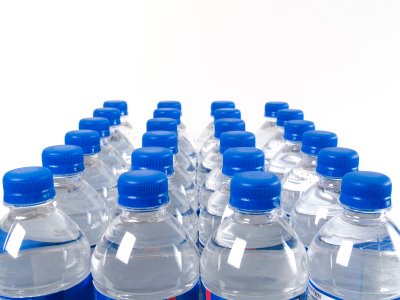
Where does that bottled water come from?
It is estimated that about 25 percent of the bottled waters
consumed in the U.S. come from municipal water supplies.
Most goes through significant processing such as reverse osmosis, deionization, activated carbon filtration and other treatments.
Read the label carefully. If it is packaged as "purified" or "drinking water," chances are it came from a municipal water supply, and unless the water has been “substantially” altered, it must state on the label that the water comes from a municipal source.
Often images on the label show mountains, snow or other bodies of water. For example, the label design on Aquafina (from Pepsi) gives me the feeling of mountains and snow; implying that Aquafina may be from a mountain spring, rather than bottled at Pepsi plants using processed municipal water. Coke’s Dasani, also one of the leading bottled water brands is processed municipal water with added minerals. Many gallon jug waters are also from municipal sources.
And just what is “natural” water?
The word "natural" is only allowed for bottled water, which is derived from springs or wells where the natural chemical (mineral and trace elements) composition of the water has not been altered as a result of treatment process.
What exactly is “natural carbonation”?
It all started when shoppers assumed that the water in their bottle of Perrier came out of the ground bubbling. And for good reason — their television ads illustrated it that way. The truth, though, is a little more complicated. The carbonation comes from a naturally occurring source in the same spring system.
Originally, according to the company, “these natural gases met and mingled together with the spring underground, rising at a constant pressure and temperature (60 degrees Fahrenheit). A desire for consistency … led French scientists to devise a more efficient means to capture the water's perfect balance of minerals and carbonation in the bottling process. Both the water and natural carbonic gas are now captured independently. They come from isolated points at different depths, within the same geologic formation. Before they come together for bottling, a filter is used to remove any natural impurities in the gas. Once combined in the bottling process, the level of carbonation found in a Perrier bottle is exactly as it is at the spring.”
So now we know.
Types of waters
Bottled water is regulated as a food product by the U.S. Food and Drug Administration (FDA). Bottled water companies must adhere to the FDA's Quality Standards, Standards of Identity (Labeling Regulations) and Good Manufacturing Practices and requires beverage companies to label their waters to define where the water came from and if it's been purified or carbonated. Bottled water can be classified with terms such as “purified,” “spring,” “sterile” and “artesian” (or “artesian well” water). All bottled water sold in the United States (whether imported or domestic) must meet all of the same regulations. Here are the classifications:
Artesian water/artesian well water
Bottled water from a well that taps a confined aquifer (a water-bearing underground layer of rock or sand) in which the water level stands at some height above the top of the aquifer.
Drinking water
Drinking water is another name for bottled water. Accordingly, drinking water is water that is sold for human consumption in sanitary containers and contains no added sweeteners or chemical additives (other than flavors, extracts or essences). It must be calorie-free and sugar-free. Flavors, extracts or essences (such as lemon-lime) may be added to drinking water, but they must comprise less than one-percent-by-weight of the final product or the product will be considered a soft drink. Drinking water may be sodium-free or contain very low amounts of sodium.
Purified water
Water that has been produced by distillation, deionization, reverse osmosis or other suitable processes and that meets the definition of purified water in the United States Pharmacopoeia (pharmacological code) may be labeled as purified bottled water. Other suitable product names for bottled water treated by one of the above processes may include "distilled water" if it is produced by distillation, "deionized water" if the water is produced by deionization, or "reverse osmosis water" if the process used is reverse osmosis. Alternatively "_____________ drinking water" can be used with the blank being filled in with one of the terms defined in this paragraph (e.g. "purified drinking water" or "distilled drinking water"). These waters are taken primarily from metropolitan water sources, run through mammoth commercial filters, and purified of chlorines, detritus, and other items inappropriate for drinking water. You may have seen vending machines outside of your supermarket that allows you to fill your own bottle for 25 or 50 cents; this is the water and process that is used and is from metropolitan sources or even the tap water adjacent to the machine’s location. They are excellent to cook with when tap water quality is an issue.
Mineral water
Waters containing not less than 250 parts per million total dissolved solids may be labeled as mineral water. Mineral water is distinguished from other types of bottled water by its constant level and relative proportions of mineral and trace elements at the point of emergence from the source. No minerals can be added.
The naturally occurring minerals and trace elements in mineral waters are considered by many to be excellent for health and digestion. Typically, these include iron, potassium, magnesium, manganese, silica, chromium, lithium, and copper. While these are healthful, the value of mineral waters versus spring waters is still debated. Available from both domestic and international sources, the prices vary tremendously based on packaging and location.
Spring water
These are waters derived from an underground formation from which water flows naturally to the surface of the earth. Spring water must be collected only at the spring or through a bore hole tapping the underground formation finding the spring. Spring water collected with the use of an external force (in other words, a pump) must be from the same underground stratum as the spring and must have all the physical properties, before treatment, and be of the same composition and quality as the water that flows naturally to the surface of the earth. Available from both domestic and international sources, spring waters are ideal for everyday drinking as well as to make coffee, tea, or foods in which the quality of the water is a critical ingredient. Prices vary considerably based both on geographic location and packaging.
Sparkling water
Water, which after treatment and possible replacement with carbon dioxide, contains the same amount of carbon dioxide that it had at emergence from the source. (An important note: soda water, seltzer water and tonic water are not considered bottled waters. They are regulated separately, may contain sugar and calories, and by law, are considered soft drinks.)
Carbonated water
The bubbles in these waters can help ease digestion, and are available from both domestic and international sources. Some have slight flavorings added such as citrus, but taste even better plain or with a slice of fresh lime or lemon. If burping is an issue, avoid them, but otherwise, they are excellent to drink after meals as a digestif. Some are heavy in sodium, so those with hypertension or sodium restrictions should drink them only occasionally.
Flavored waters
These may be compared to soda pop, but infinitely lighter in flavor and absolutely lighter in sugars and sweeteners. They give just a hint of flavors like citrus or berries, have either no or modest amounts of sweeteners from high fructose corn syrup to sugars or honey. They are likely not to be completely calorie-free, but are modest in carbohydrates and calories when consumed sparingly.
Waters with healthful additives
These waters contain everything from additional minerals, vitamins, and other ingredients that make these more a health drink than “just water.” If this is the only way to get your spouse to drink water, great; otherwise, it’s a very expensive way to get your H2O; and in some cases the packaging and the labeling can be misleading. Remember that most Americans do not have vitamin deficiencies and buying waters to add vitamins to your diet might be little more than a waste of money.
Distilled water
These waters are mineral-free, so they’re perfect for curling irons, clothes irons and steamers, humidifiers, and any appliance that requires water. By using distilled waters, you can avoid the mineral muck that often clogs up appliances. Some people view distilled waters as good to drink because it is so pure, but naturally occurring minerals in waters are actually good for you.
Tap water
Many municipal water supplies, such as New York City, boast water that is as tasty and pure as the most expensive bottled varieties. By law, municipal water supplies must supply its customers a chemical analysis of their water composition. If you haven’t received yours, contact your local water supply. (Many now post their analysis on their Web sites.)
Water filters
Consumers can filter their municipal water by attaching a commercial filter to the tap, using a pitcher with a carbon filter in it, or buying refrigerators with built-in filters that make both filtered ice and filtered water. These are very good, but be sure to change the filters as recommended.
 Have you ever wondered what the most popular stores were?
 IN Second place, the runner up is the store known as "Macy's"
 Sliding into Third is Sear's!
 The only Electronics store in the list. Best Buy takes the number 4.
 And to conclude our list of Most Popular Stores, Target finishes it off in 5th place.